
Every vendor, every conference, and every trending post is telling you the same thing right now: adopt AI or fall behind. Some of that is true. A lot of it is noise designed to sell you something.
So here’s the honest version. In 2026, the question is no longer “should my business use AI?” you almost certainly already do, even if only through the tools baked into your email, your accounting software, or your storefront. The real question is sharper and more expensive to get wrong:
Should you build your own AI, or simply buy what already exists?
This guide answers that in plain language. No jargon left unexplained, no promises that AI will magically fix your business, and no invented statistics just how to think about the decision when you’re the one signing the checks.
First, what “build with AI” actually means
“Building with AI” gets thrown around loosely, so let’s separate it into three concrete paths. Almost every small business decision falls into one of them.
1. Buy off-the-shelf (use it as-is). You subscribe to a tool that already has AI inside it an AI writing assistant, a chatbot for your website, AI-powered analytics in your e-commerce platform. You don’t build anything. You configure and use.
2. Build custom (make something of your own). You create an AI-powered tool tailored to your business for example, a customer-support assistant trained on your product manuals, or an internal tool that reads your invoices and sorts them automatically. This usually means combining an existing AI “engine” (a model accessed through an API) with your own data and workflow logic.
3. The hybrid path (buy the engine, build the wrapper). This is where most serious work actually lands in 2026. You don’t train an AI model from scratch almost no small business should. Instead, you rent a ready-made model from a provider and build a thin, custom layer around it: your data, your rules, your interface. You get customization without the cost of building the hard part.
A quick technical note that saves a lot of confusion: when people say a small business is “building AI,” they almost never mean training a model from zero. Training a large model requires enormous data, computing power, and specialized talent that’s out of reach and unnecessary for nearly all small businesses. “Building” today means assembling connecting existing models to your specific data and processes.
When Buying is the Right Call
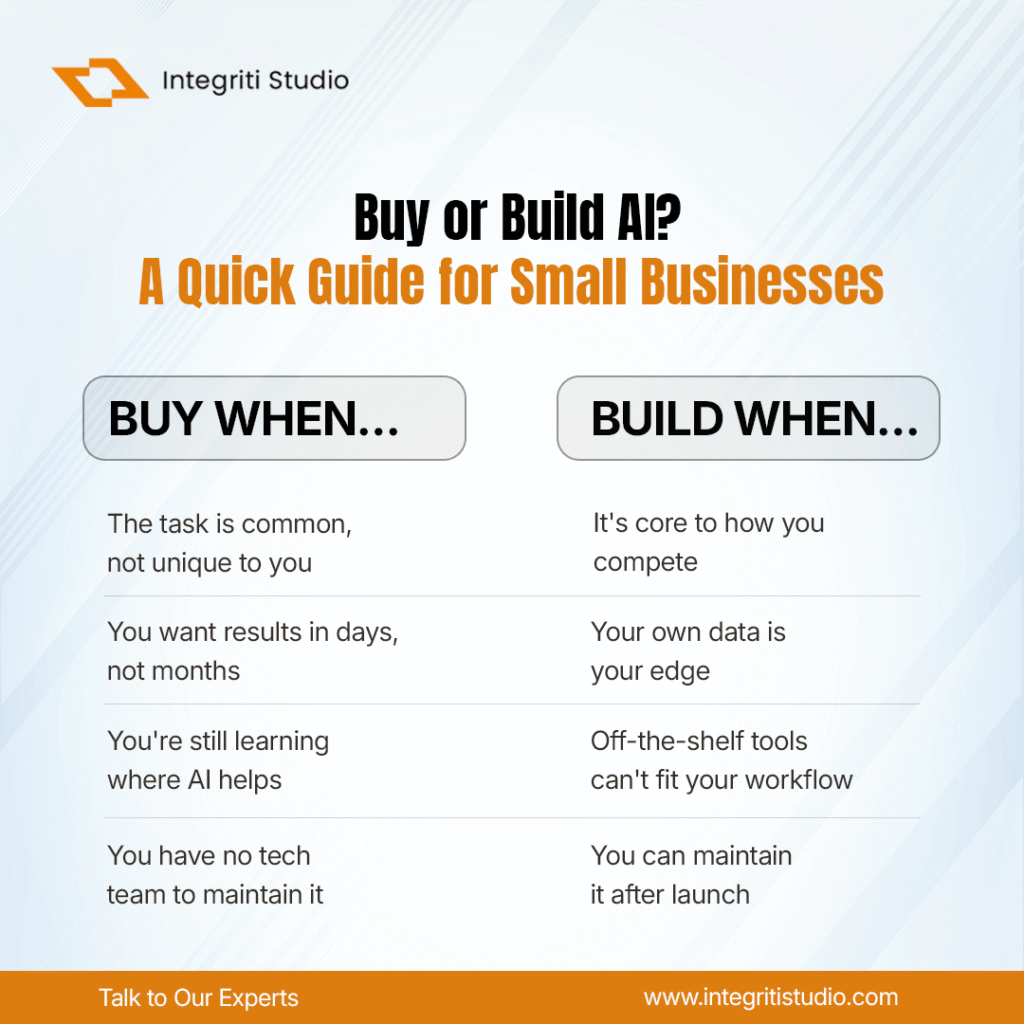
Lean toward buying an existing tool when:
- The task is common, not unique to you. Writing product descriptions, drafting emails, summarizing calls, basic customer chat thousands of businesses need these, so good tools already exist. Building your own would be reinventing the wheel.
- You want results in days, not months. Off-the-shelf tools deploy fast.
- You’re still learning where AI helps. If you don’t yet know which tasks are worth automating, buying lets you experiment cheaply before committing.
- You don’t have technical staff or a reliable partner. Buying shifts the maintenance burden onto the vendor.
The recurring wisdom across the industry in 2026 is worth repeating: buy to learn, build to differentiate. Start by buying tools to discover where AI genuinely moves the needle for you and only consider building once you’ve found a spot where a custom solution would give you an edge competitors can’t copy.
When Building is Worth it
Building starts to make sense when:
- The AI touches how you compete, not just how you operate: If it’s core to your product or your unique advantage, owning it matters. If it’s a background efficiency, buying is usually smarter.
- Your data is your edge: If you have proprietary information years of customer history, specialized documents, unique operational data a custom tool built on that data can do things no generic product can.
- Off-the-shelf tools can’t fit your workflow: When you’ve genuinely outgrown what vendors offer, and the misfit is costing you real money.
- You have the means to maintain it: This is the one people underestimate more on that next.
Not sure whether your business should buy or build? We help small businesses cut through the AI hype and find the handful of use cases actually worth the investment before you spend a dollar on the wrong thing.
Book a free 30-minute AI strategy call
The Technical Realities Non-Technical Owners Should Know
This is the part most sales pitches skip. If you are going to build AI, walk in knowing these four truths.
1. AI is only as good as your data: A custom AI tool learns from the information you give it. If your data is messy, incomplete, or scattered across ten places, the AI’s output will be unreliable sometimes confidently wrong. Cleaning and organizing your data is often the biggest, least glamorous part of the job.
2. The great demo trap is real: AI tools are remarkably easy to get to a working demo and remarkably hard to make reliable for every real-world case. A prototype that dazzles in a meeting may handle only the easy 80% of situations. The last 20% the edge cases, the exceptions, the “what happens when a customer types something weird” is where most of the real cost and time lives. Budget for it.
3. It’s not set it and forget it: AI tools need ongoing attention: models get updated, your data changes, and outputs need monitoring, so quality doesn’t quietly drift. Maintenance is a real, recurring cost not a one-time build.
4. Governance is not optional: Who checks the AI’s answers? What happens when it makes a mistake in front of a customer? How is customer data handled and protected? These aren’t advanced concerns. These are day-one questions, especially as data and AI regulations continue to evolve. Have a human-review plan before you go live.
A note on figures: you’ll see a lot of confident statistics online about AI success rates, ROI, and adoption. Treat them cautiously many trace back to marketing material rather than independent research, and the field moves fast. Base your decision on your own numbers and a small, measurable pilot, not on someone else’s headline stat.
The clearest trend in 2026 isn’t “AI replaces everything.” It’s practical, targeted adoption businesses picking three or four specific, repetitive tasks and applying AI precisely to those, rather than chasing a grand transformation. For retail and e-commerce specifically, the highest-return uses keep showing up in the same places: product discovery and recommendations, personalized customer experiences, and AI-assisted customer service.
If you want to see where operators are actually placing their bets rather than reading about it — this is exactly the focus of eTail Boston 2026, happening August 10–12, 2026 at the Sheraton Boston, Massachusetts.
Organized by Worldwide Business Research, it’s one of the longer-running U.S. e-commerce and omnichannel retail conferences, and the 2026 agenda leans heavily into AI-driven personalization, customer experience, and omnichannel growth with a practical, case-study bent rather than high-level theory. For a small business weighing how far to go with AI, events like this are a low-risk way to pressure-test your thinking against real operators before you invest.
The Bottom Line
The businesses that win against AI in 2026 won’t be the ones that spent the most or moved the fastest. They’ll be the ones that were honest about what they actually needed and disciplined about ignoring the rest.
Ready to make a confident, no-hype AI decision for your business? Whether you should buy, build, or start with a small pilot we’ll help you map the right path for your goals, budget, and data. No jargon, no pressure.
Get your free AI readiness assessment fill out the form and talk to our team