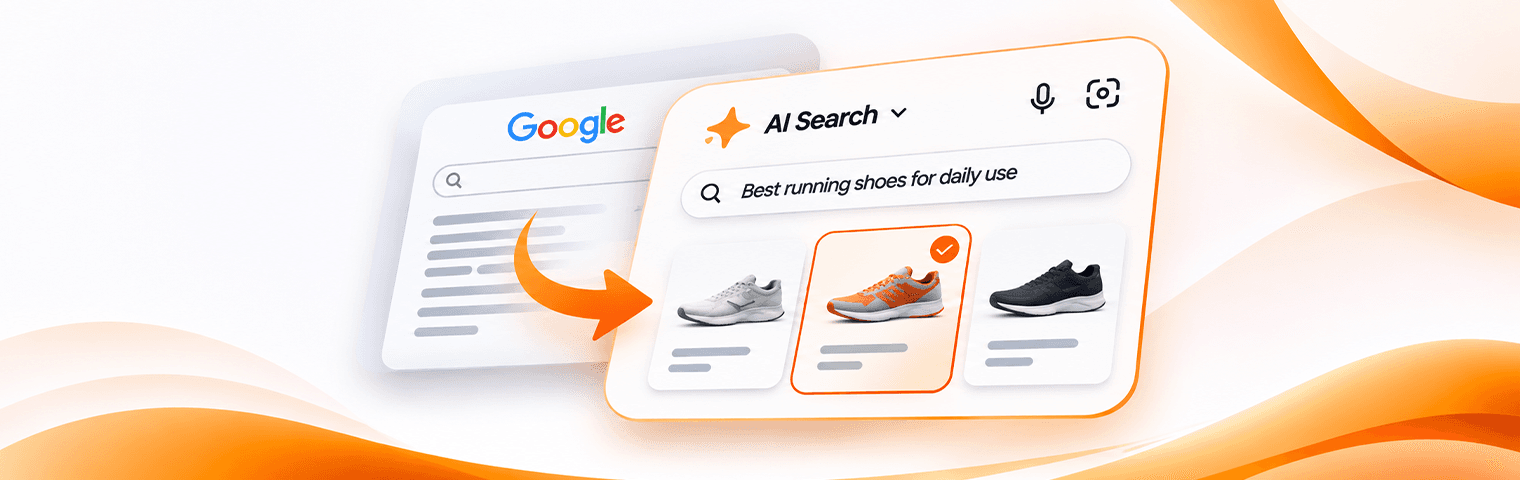
For twenty years, getting found online meant one thing: ranking on Google. That assumption is now breaking, faster than most store owners realize. A growing share of shoppers are starting their product research inside AI tools like ChatGPT, Gemini, Perplexity, and Claude, and getting a short, confident answer instead of a page of links.
This is not a prediction. It is already measurable. The question for every online store is simple: when an AI recommends products in your category, does it mention you, or does it skip you entirely?
Here is what the data actually shows, and what it means for how your store needs to be built.
The shift is real, and it is happening now
The numbers from 2026 make the trend hard to ignore.
Adoption has gone mainstream. According to a Search Engine Land survey (April 2026), 77.6% of consumers said they had used AI for shopping in the past six months, and 43% report using AI for shopping weekly or more. A separate L.E.K. Consulting study found that 46% of AI users now start their purchase research on a stand-alone AI platform like ChatGPT or Perplexity, up from 25% in 2024, while the share starting on traditional search fell from 43% to 24% over the same period.
That last figure is the heart of the shift. The front door to product discovery is moving.
AI tools are now seen as genuinely useful for shopping, not just novelty. Similarweb (March 2026) found that 35% of US consumers rated AI tools as most useful at the product-discovery stage, versus just 13.6% for search engines. And Adobe reports that around 1 in 4 customers now turn to AI platforms as their primary source for product research and recommendations, ahead of brand websites and online reviews.
The scale is significant. OpenAI’s own research indicates roughly 50 million shopping-related queries happen inside ChatGPT every day. ChatGPT also surpassed 800 million monthly active users in early 2026 (per multiple reports), which makes it one of the largest product-research surfaces in the world.
An honest caveat worth stating: this is a shift, not a completed takeover. Google is still the dominant search channel, and one Fractl / Search Engine Land data point even shows the share of consumers who find AI search “more helpful” than traditional search fell from 82% to 54% in a year, a sign the early hype is settling into realistic, steady adoption. So the accurate framing is not “Google is dead,” but “a major new discovery channel has arrived, and it is growing fast.”
Why this matters more than it first appears
Two findings make AI visibility a bottom-line issue, not just a traffic one.
First, AI-referred shoppers convert unusually well. One widely cited study found AI search traffic converts at around 14.2%, compared to roughly 2.8% for Google organic, and that AI visitors spend significantly more time on-site. Whether or not those exact figures hold for every store, the pattern is consistent across sources: people arriving from an AI recommendation tend to arrive more informed and more ready to buy. That makes each one more valuable.
Second, and this is the uncomfortable part, if your store is not part of the AI’s answer, you are often invisible. On Google, you compete for a spot on page one. With AI, there frequently is no page two. Either the model names your product, or the shopper never learns you exist. Many brands are discovering that despite heavy SEO investment, they receive zero mentions in AI responses for queries directly relevant to their category.
This is also a B2B issue, not only a consumer one. A March 2026 analysis of 680 million AI citations (Averi) found that roughly 73% of B2B buyers now use AI tools as part of their vendor research. So whether you sell products or services, the people evaluating you are increasingly asking an AI first.
How AI actually chooses what to recommend
Here is the reassuring part, and the practical one. AI shopping tools do not reward flashy design or big ad budgets. They reward structured, trustworthy, machine-readable information. Early evidence suggests the AI shelf is still closely tied to the open web: Semrush (January 2026) found that ChatGPT’s top recommended product appeared in Google Shopping’s first three results about 75% of the time in their sample. In other words, strong fundamentals still carry over, for now.
What that means in practice is that “AI visibility” is mostly the same disciplined work that has always made a store trustworthy and findable, applied deliberately:
Clean, complete, structured product data: An AI can only recommend a product it can clearly understand. Complete specifications, accurate descriptions, correct pricing, and proper variant data are the foundation. Gaps here are the single most common reason a store gets skipped.
Proper structured data (schema markup): Machine-readable markup helps AI tools interpret what each product and page actually is. This is table stakes for being parsed correctly.
Genuine, helpful content and reviews: AI models lean heavily on content that answers real questions, and on third-party signals. Notably, ChatGPT’s top citation sources have included places like Wikipedia and Reddit, a reminder that being discussed and reviewed across the web matters, not just what is on your own site.
Speed and clean technical foundations: The same performance and structure that help human shoppers and Google also help AI crawlers read and trust your store.
The through-line: the brands that quietly did the fundamentals right are already ahead. The ones relying on a thin, slow, or poorly structured store are about to feel it twice over, once in Google, and now again in AI.
How to find out where your store stands
You do not need a full audit to get a first signal. Three quick checks:
First, open ChatGPT, Gemini, or Perplexity and ask it to recommend products in your category, the way a customer would. See whether your store or products come up at all. If they do not, that is your answer.
Second, look hard at your product data. Pick your best seller and ask honestly: are the attributes complete and accurate? Is the description specific and genuinely useful, or generic filler? If a machine had only this data to go on, could it confidently recommend the product?
Third, check whether your store has proper structured data and clean technical foundations, or whether that work has been skipped.
If those checks make you uncomfortable, that discomfort is useful. It is far cheaper to fix this now, while the space is still forming, than to discover in a year that AI tools have been quietly routing shoppers around you.
The honest bottom line
AI search is not replacing Google overnight, and anyone telling you it is should be read with skepticism. But it has arrived as a real, fast-growing, high-converting discovery channel, and the shoppers using it are often the ones most ready to buy.
The good news is that getting ready is not exotic. It is the fundamentals done properly: clean and structured product data, helpful content, strong reviews, and a fast, well-built store. The exact same foundation that has always made a store worth trusting is what makes it legible to AI.
The rules of being found are changing. The businesses that treat their product data and store structure as a genuine asset, not an afterthought, are the ones AI will choose to recommend.
Where Integriti Studio comes in
Making your store genuinely visible, to Google, to AI, and to the customers using both, is exactly the kind of work we do. We build the clean, fast, well-structured stores and the proper technical foundations that AI tools reward, so the demand that is out there can actually find you.
If you are not sure whether your store is built to be found in the age of AI, that is worth checking before the gap gets wider
Want your store built to be found, by Google and AI alike? Let’s talk.