
Why do some WordPress websites scale smoothly while others struggle to keep up with business goals? The difference rarely lies in the platform itself. Website performance is shaped by multiple factors, including development quality, architectural decisions, long-term maintenance, and how well evolving technologies are adopted. As a site owner, you may already rely on WordPress for flexibility, but without professional execution, even powerful tools can underperform.
WordPress in 2026 will be shaped by key 2025 changes, including enhanced AI integration, improved plugin ecosystems, and performance-focused updates from WordPress 6.9. Site owners who adopt professional development, maintain their builds, and leverage these tools will gain long-term business benefits, future-proofing their websites for real-time collaboration and growth.
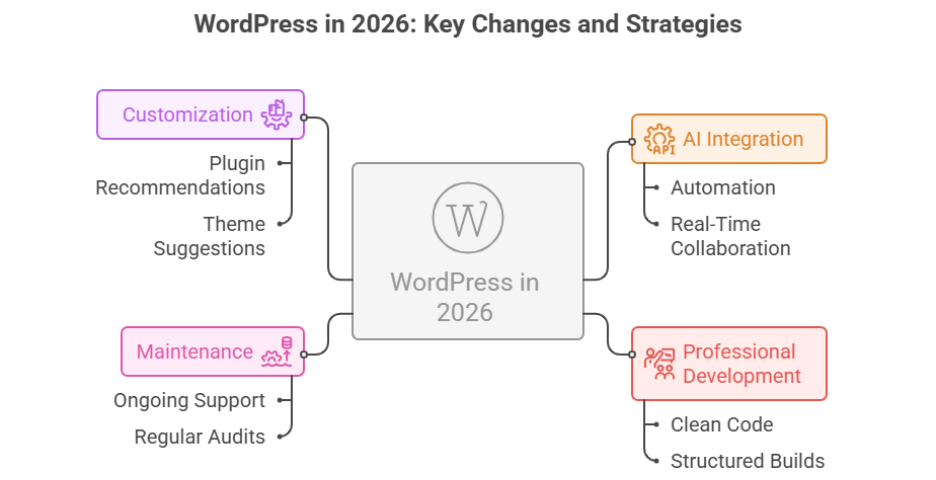
Professional development plays a critical role in turning a website into a business asset. Clean code, structured builds, and informed updates ensure stability as platforms evolve. Good design is not only visual, but it also improves usability, conversion flow, and trust. Ongoing support and maintenance protect your investment, especially when updates introduce new capabilities. For example, while a basic setup may cost a few hundred dollars, long-term-ready builds often require thoughtful planning and higher upfront investment to deliver measurable returns.
Looking ahead to WordPress in 2026, the shifts introduced during 2025 and the growing role of AI will define which websites stay competitive. This blog explores which changes matter long-term, how it adapts, and how smart decisions today support sustainable growth beyond 2026.
How site owners rely on WordPress AI in 2026
As WordPress evolves, site owners are increasingly relying on AI to streamline workflows, enhance performance, and deliver better user experiences. The future of WordPress in 2026 will emphasize automation, real-time collaboration, and smart integrations, allowing businesses to achieve measurable business benefits while maintaining flexibility.
AI Integration and Real-Time Collaboration
One of the most significant 2025 changes is the integration of AI directly into the dashboard. With the abilities API and other AI tools, site owners can automate repetitive tasks, optimize content, and gain insights for performance optimization. Real-time collaboration features allow teams to work on websites simultaneously, improving efficiency and minimizing errors. This is especially critical for businesses relying on WooCommerce or multi-user blogging platforms, where content speed and accuracy directly impact revenue.
Customization and Automation for Business Needs
Modern WordPress development now supports custom development and AI-driven automation. For instance, an AI client can suggest plugins and themes, recommend performance optimization features, and help maintain core security and bug fixes. This reduces the dependency on expensive plugins and allows site owners to focus on content strategy and business needs rather than manual site management.
Staying Updated with the WordPress Roadmap
The AI team continues to evolve the platform based on feedback from the State of the Word 2025 report. By understanding the roadmap and future development, site owners can prioritize updates, adopt new features, and ensure their sites remain competitive. Leveraging AI for real-time collaboration, workflow management, and customization ensures that every site aligns with modern best practices while offering business benefits that extend well into 2026.
Preparing for the Future of WordPress
To maximize the advantages of WordPress AI, site owners should invest in training, regular audits, and customization aligned with their business needs. The combination of professional development, core platform enhancements, and AI-driven automation positions WordPress in 2026 as a platform where efficiency, innovation, and scalability converge. Companies that embrace these tools now will gain a competitive edge, ensuring that their websites deliver long-term value and measurable ROI.
Conclusion
The journey of WordPress in 2026 is built on the critical shifts introduced during 2025, from AI integration to improved plugin ecosystems and performance-focused updates. For site owners, success is no longer just about choosing a platform—it’s about leveraging professional development, smart customization, and AI-driven automation to maximize efficiency and deliver measurable business benefits.
By staying updated with the roadmap, adopting real-time collaboration, and prioritizing structured maintenance, you can future-proof your website while enhancing user experience, security, and scalability. Thoughtful investment in design, development, and ongoing support ensures your site not only performs well today but continues to grow and adapt to emerging technologies.
Ultimately, WordPress in 2026 rewards those who make informed, strategic decisions. By embracing AI, automation, and professional best practices, site owners can transform their websites into resilient, high-performing business assets that drive long-term value, efficiency, and competitive advantage.